AI Infrastructure Stack
EU-Sovereign AI Stack
All data stays in the EU. For teams building AI features where GDPR compliance, data residency, and European hosting are requirements, not nice-to-haves.
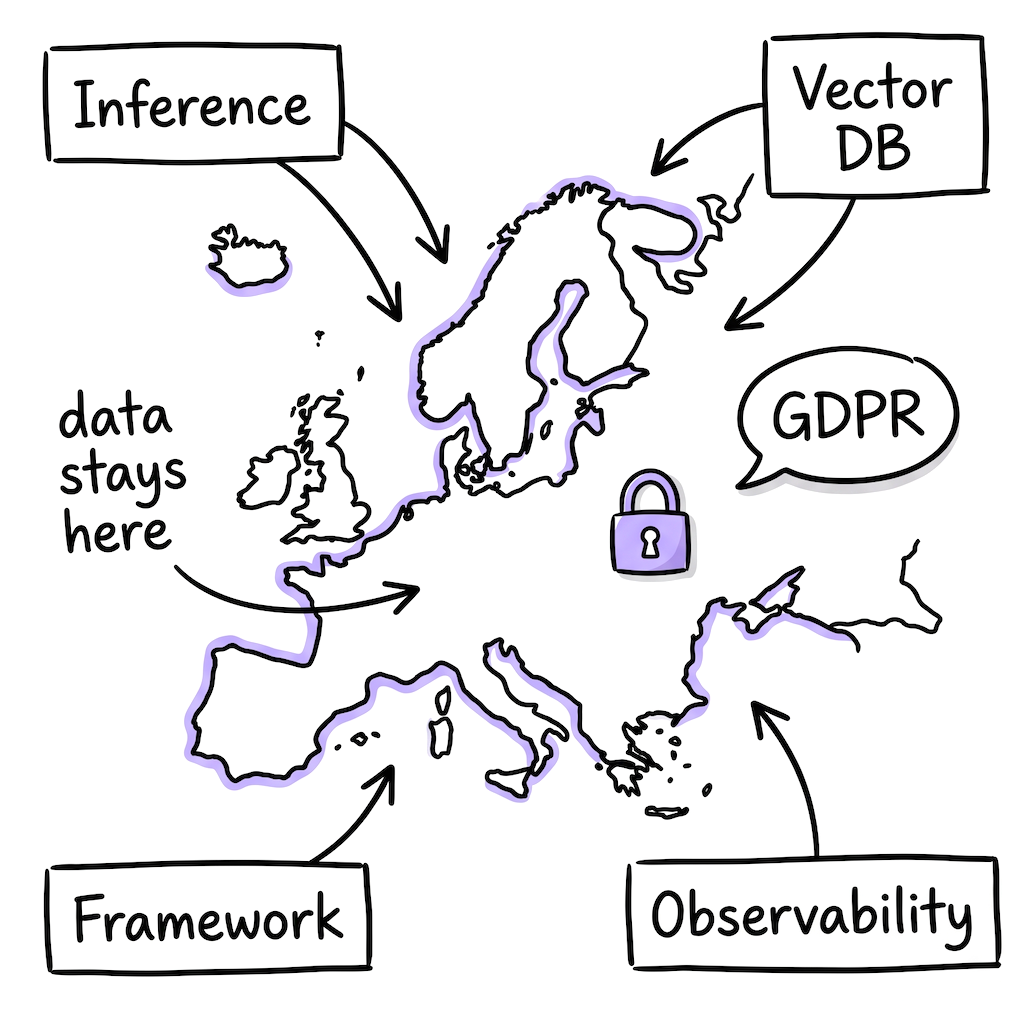
Why build an EU-sovereign AI stack?
If prompts or model outputs contain personal data, every call to an inference API is a regulated processing event under GDPR. Sending that data to a US provider triggers international transfer rules (Schrems II), which means additional safeguards, legal review, and risk. Running inference inside the EU sidesteps that entirely.
The EU AI Act becomes binding in August 2026 and adds documentation and transparency requirements for AI systems. Having your full stack on EU infrastructure, with EU-based providers who fall under EU jurisdiction, makes audit trails and compliance documentation simpler.
Practically, almost no team runs a fully sovereign stack from day one. The common path is to prototype with whichever provider is fastest, then swap the inference layer to an EU provider before production. Most tools listed here use OpenAI-compatible APIs, so that swap is a URL and API key change.
The stack below covers four layers: inference, frameworks, vector databases, and observability. Every tool is either EU-based, open source (so you can self-host on EU infrastructure), or both.
Inference API
☁️European inference providers running open-source models in EU data centers. Most offer OpenAI-compatible APIs, so switching between them (or to a non-EU provider later) is straightforward.

French company. Open-source and commercial models. La Plateforme runs in EU data centers. One of the earliest and largest European inference providers.

French cloud provider. Generative APIs with Qwen, Llama, DeepSeek, Mistral models. All servers in Paris. 1M free tokens for new accounts.

Swedish. Serverless and dedicated inference. No data leaves Sweden. OpenAI-compatible API. Free credits on signup.
Framework
🔧For simpler use cases, the provider SDK (Mistral, OpenAI) can be enough. A framework helps when you need RAG pipelines, multi-step agents, or visual workflow building.

By deepset (Berlin). Pipeline-based architecture for RAG and search. 100+ connectors. Used by Airbus, The Economist, NVIDIA. Strong document processing.

By the Pydantic team (UK). Type-safe agent development. Not EU-hosted as a service, but open source, so you run it wherever you want.

German. Visual workflow automation with AI integrations. Self-hostable. Good for teams where non-developers need to build AI workflows.
Vector Database
🗄️The EU vector database options are genuinely strong. Qdrant and Weaviate are both top-tier products that happen to be European, not compromise choices.

Berlin-based. Fast filtered search, multi-tenancy support. Managed cloud with EU hosting or self-host on your own infra.

Amsterdam-based. Built-in vectorization modules. Managed cloud or self-hosted. Good for hybrid search (vector + keyword).

Norwegian (Yahoo/Oath origin). Combines vector search, text search, and structured data in one engine. More complex to operate, but handles scale well.
Observability
🔍Langfuse is the standout here. Open source, self-hostable, EU-based. If you need traces to stay in the EU, self-hosting Langfuse on your own EU infrastructure is the cleanest path.

Berlin-based. Open source (MIT), self-hostable. Tracing, evals, prompt management. The default choice for EU-sovereign observability.

Netherlands-based. Open source. LLM guardrails, evaluations, and analytics. Smaller community than Langfuse but actively developed.

French. Open-source testing for LLMs. Focuses on detecting hallucinations, bias, and security issues. More evaluation than tracing.
Things to keep in mind
- EU-sovereign doesn't mean closed off. Most tools listed here use OpenAI-compatible APIs. You can prototype with a US provider and switch to an EU one before going to production.
- "EU-hosted" means the company is based in Europe and offers hosting in EU data centers. For strict sovereignty requirements, verify the specific data center locations and legal entity with each provider.
- Open-source tools (Haystack, Qdrant, Langfuse) can run on any EU infrastructure you control. That's the strongest sovereignty guarantee: you own the deployment.
- The European AI ecosystem is growing fast. This page reflects what's available in 2026, but check back as new providers launch.
Frequently asked questions
Which AI inference providers host data in the EU?
Mistral (France), Scaleway (France, servers in Paris), Berget AI (Sweden), Nebius (Netherlands), OVHcloud (France), and evroc (Sweden) all run inference in EU data centers with OpenAI-compatible APIs.
Are there EU-based vector databases?
Qdrant (Berlin) and Weaviate (Amsterdam) are both EU-based, open source, and offer managed cloud hosting in the EU. Both can also be self-hosted on your own EU infrastructure.
Can I build a GDPR-compliant AI stack entirely in Europe?
Yes. Every layer of the AI stack (inference, frameworks, vector databases, observability) has EU-based options. Open-source tools like Haystack, Qdrant, and Langfuse can run on any EU infrastructure you control.
Is EU-sovereign AI more expensive than US providers?
Not necessarily. Scaleway offers 1M free tokens for new accounts. Berget AI has free credits on signup. The open-source tools (Qdrant, Langfuse, Haystack) are free to self-host. Per-token pricing is competitive with US providers.
What does the EU AI Act mean for AI infrastructure?
The EU AI Act becomes binding in August 2026. It adds transparency and documentation requirements for AI systems, especially high-risk ones. Running inference on EU infrastructure with EU-based providers simplifies compliance because data residency, audit trails, and processing records stay within EU jurisdiction.
Last updated: April 2026

Is your product missing?