AI Infrastructure Stack
Self-Hosted AI Stack
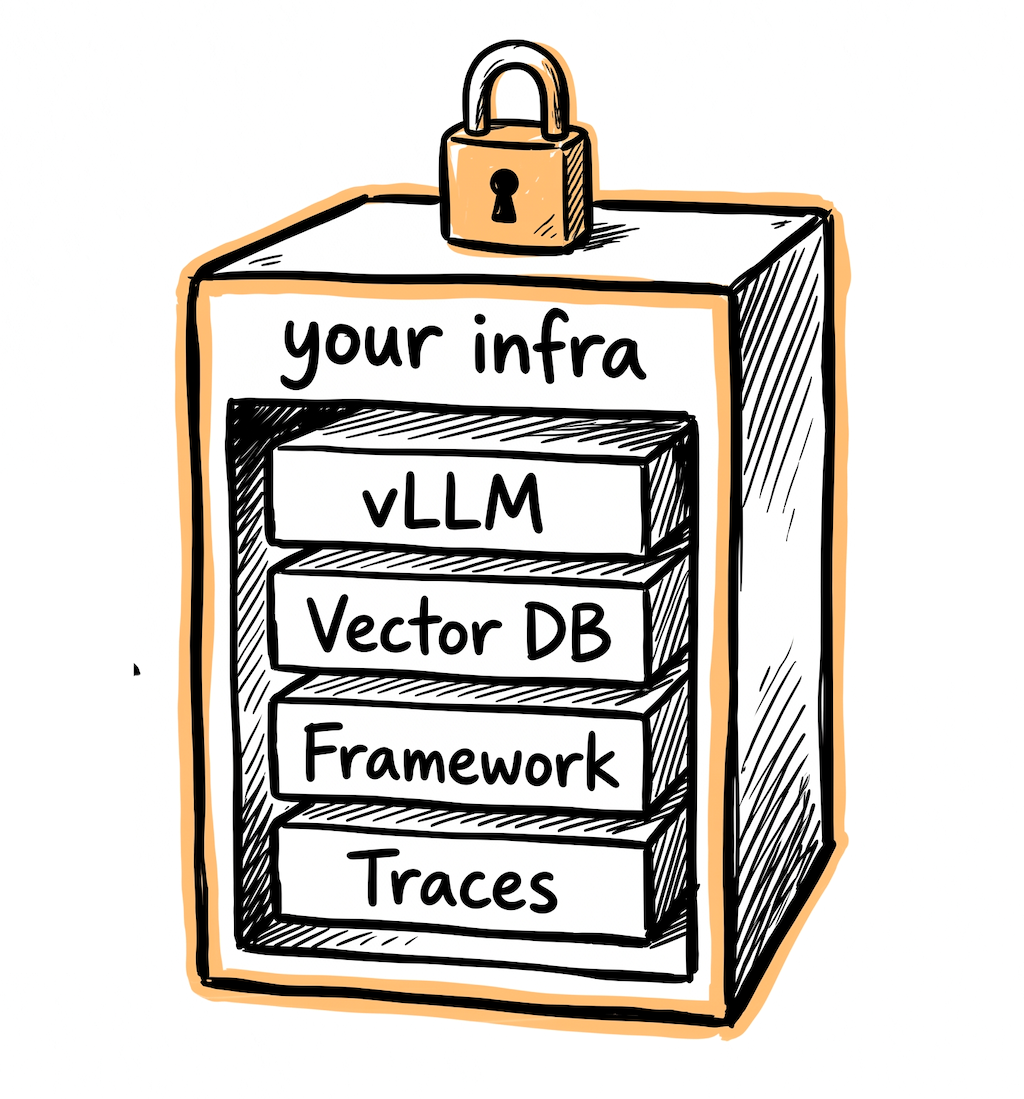
Run everything on your own infrastructure. For teams that need full control over data, want to avoid API dependencies, or have compliance requirements that rule out third-party services.
Inference Engine
☁️Self-hosted inference means running an open-source model on your own GPUs. You need a serving framework that handles batching, streaming, and model loading efficiently.

The most widely used open-source inference engine. PagedAttention for efficient memory management. OpenAI-compatible API server. Supports most popular open-source models.

Production-grade open-source serving framework. RadixAttention shares KV cache across requests with shared prefixes, which helps with multi-turn chat and few-shot prompting. Strong at structured outputs and tool-use workloads. Apache 2.0, used in production by xAI, LinkedIn, and ByteDance.

Model serving framework with built-in containerization. Package any model as a production API with autoscaling, batching, and monitoring. More opinionated than raw vLLM.
GPU Compute
🖥️You need GPUs to run the models. These providers offer on-demand GPU instances where you control the full environment. Cheaper than inference APIs at scale, but you manage the infrastructure.

On-demand and spot GPU instances. Serverless GPU option for bursty workloads. Pre-built templates for vLLM and common models. Popular with indie developers.

Serverless GPU compute with a Python-first developer experience. Define your environment in code, deploy with one command. Handles autoscaling and cold starts.

GPU marketplace with competitive pricing. Rent GPUs from individual providers. Less polished UX but often cheaper than centralized cloud providers.
Vector Database
🗄️For RAG or search features, you need a self-hostable vector database. All three options below can run on your infrastructure via Docker or Kubernetes.

Written in Rust. Single binary, easy to deploy. Good filtered search and multi-tenancy. Docker or Kubernetes deployment.

Designed for scale. Handles billions of vectors. Kubernetes-native deployment. More complex to operate than Qdrant but stronger at very large scale.

If you already self-host Postgres, add pgvector. No new service to manage. Good up to ~10M vectors. Pair with full-text search for hybrid retrieval.
Observability
🔍Self-hosted observability means your traces and logs stay on your infrastructure too. Both options below are open source and self-hostable.

Self-host via Docker or Kubernetes. MIT licensed, no feature gates on the self-hosted version. Tracing, evals, prompt management.

Open source, OpenTelemetry-native. Self-host and pipe traces into your existing Grafana or Datadog setup. Good for teams with established observability infrastructure.

Open-source LLM testing framework. Focuses on detecting hallucinations, bias, and security issues. Self-hostable. Complements tracing tools with evaluation.
Things to keep in mind
- Self-hosting trades per-token costs for infrastructure costs and operational work. It makes sense at scale (thousands of requests per day) or when data sovereignty requires it. For small workloads, managed APIs are usually cheaper and simpler.
- vLLM + a GPU instance is the standard starting point. GPU requirements depend on model size: a 7B model fits on a single GPU, larger models (70B+) may need multiple GPUs or quantization. Benchmark your specific model before committing to hardware.
- Open-source models have caught up significantly. Llama, Mistral, Qwen, and DeepSeek families cover most production use cases. Check license terms, some are more permissive than others.
- You can mix self-hosted and managed. Run your inference on your own GPUs but use Langfuse cloud for observability, or vice versa. Not everything needs to be self-hosted.
Frequently asked questions
What do I need to self-host AI inference?
An inference engine (vLLM is the standard), GPU compute (RunPod, Modal, or your own hardware), and an open-source model (Llama, Mistral, Qwen, DeepSeek). GPU requirements depend on model size: 7B models fit on one GPU, 70B+ may need multiple GPUs or quantization.
Is self-hosting AI cheaper than using APIs?
At scale (thousands of requests per day), yes. You trade per-token costs for fixed infrastructure costs. For small workloads, managed APIs are usually cheaper and simpler. The crossover point depends on your volume and model choice.
Can I self-host observability for LLMs?
Yes. Langfuse is open source (MIT) and self-hostable via Docker or Kubernetes with no feature gates. Arize Phoenix is also open source and can pipe traces into your existing Grafana or Datadog setup.
Which open-source models are best for self-hosting?
Llama, Mistral, Qwen, and DeepSeek families cover most production use cases. Check license terms as some are more permissive than others. vLLM supports most popular models out of the box.
Last updated: April 2026

Is your product missing?