
OpenRouter
Unified API for 400+ AI models across 60+ providers, OpenAI SDK-compatible, pay-as-you-go
OpenRouter is a single API endpoint that routes requests to over 400 models from providers including Anthropic, OpenAI, Google, Meta, Mistral, and DeepSeek. It is OpenAI SDK-compatible, so switching from a direct provider integration requires minimal code changes. Pricing is pay-as-you-go with credits, no subscription required. OpenRouter handles provider failover automatically, routing to backup providers if one goes down. Data policies are configurable per request, letting developers control which providers see their prompts. Processes 80 trillion tokens monthly across 8 million users.
Pricing: Pay-as-you-go
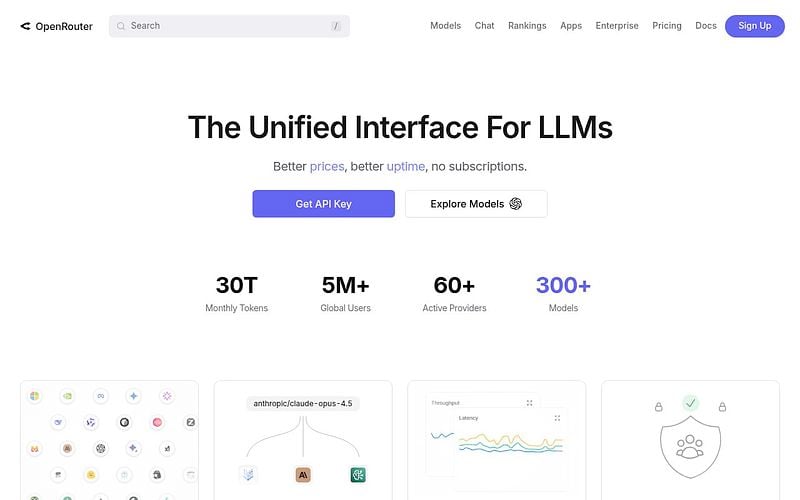
OpenRouter sits between your application and AI model providers. You send requests to one API, and OpenRouter routes them to the right provider. It supports over 400 models from 60+ providers, including Anthropic Claude, OpenAI GPT, Google Gemini, Meta Llama, Mistral, DeepSeek, and many others. The API is OpenAI SDK-compatible.
The main value proposition is convenience and reliability. Instead of managing API keys and client libraries for each provider, you use one endpoint. If a provider goes down, OpenRouter can automatically failover to another provider serving the same model. You can also set data policies to control which providers receive your prompts, useful for compliance requirements.
Pricing is pay-as-you-go. You buy credits and spend them across any model. Some models are available for free (with rate limits), while others are priced at or near the direct provider rate. OpenRouter adds a small margin on some models. There is no subscription or minimum spend.
OpenRouter is useful if you want to experiment across many models without setting up separate accounts, or if you need provider redundancy for production workloads. The trade-off is an extra hop of latency and giving a third party access to your prompts. For latency-sensitive applications where you know exactly which model you want, going direct to the provider may be better.
OpenRouter Alternatives
Explore 147 products in the Inference APIs category. View all OpenRouter alternatives.

EUrouter
European AI gateway that routes to 100+ models with EU data residency


Cerebrium
Serverless GPU infrastructure for deploying AI models with sub-5 second cold starts

vLLM
High-throughput LLM inference engine with PagedAttention for efficient GPU memory usage

Baseten
AI inference platform for deploying and serving ML models with autoscaling and optimized infrastructure
Compare
Work on OpenRouter? Feature it at the top of Inference APIs.
Is your product missing?