Langroid
Multi-agent LLM framework using message-based task delegation inspired by the Actor model
Langroid is a Python framework for building LLM applications using multi-agent programming. Developed by researchers from CMU and UW-Madison. Agents are first-class citizens that collaborate by exchanging messages through a hierarchical task delegation system inspired by the Actor model. Supports function calling via Pydantic, vector store integration with Qdrant, Chroma, and LanceDB for RAG, and works with any LLM (local or remote API-based). Lightweight and extensible with ready-to-use example demos.
Pricing: Free
What is Langroid?
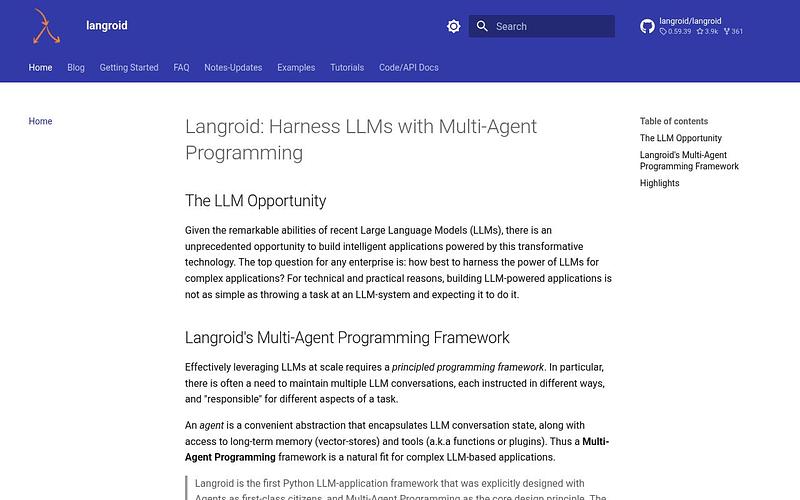
Langroid is a Python framework for building LLM applications using multi-agent programming. Created by researchers from CMU and UW-Madison, it treats agents as first-class citizens rather than wrapping them around chain abstractions. The project has 4,000+ GitHub stars and is licensed under the MIT license.
Architecture
The core abstraction is an Agent class that encapsulates LLM conversation state, vector-store access, and tools. A Task class wraps agents, provides instructions, and enables hierarchical task delegation between multiple agents. Agents communicate through message-passing rather than shared state.
Key Features
Langroid supports RAG with source citation, function-calling via Pydantic tool definitions, and integration with multiple vector stores (Qdrant, Chroma, LanceDB, Pinecone, Weaviate, PostgreSQL). It works with OpenAI, local models via Ollama, and 100+ providers through LiteLLM. The framework includes async operations, task batching, Redis-based LLM caching, and message lineage tracking for debugging.
How It Compares
Langroid does not use LangChain internally, positioning itself as a lighter-weight alternative. Users have noted it is simpler to set up than CrewAI and AutoGen for multi-agent workflows. The trade-off is a smaller ecosystem and community compared to LangChain or LlamaIndex.
Who Should Use It
Developers building multi-agent Python applications who want a framework that emphasizes modularity and loose coupling between agents. Particularly suited for RAG pipelines, tool-using agents, and hierarchical task orchestration.
Langroid Alternatives
Explore 41 products in the Frameworks & Stacks category. View all Langroid alternatives.

llmkit
One LLM client API for 20+ providers, in Go, TypeScript, Python and Rust

DSPy
Framework for programming, not prompting, language models with automatic prompt optimization

LangChain
LangChain gives developers a framework to construct LLM‑powered apps easily.

Mastra
TypeScript-first AI framework for building agents, RAG pipelines, and workflows

Ollama
Run large language models locally with a single command

Google ADK
Open-source agent development kit from Google for building multi-agent systems
Also listed in
Work on Langroid? Feature it at the top of Frameworks & Stacks.
Is your product missing?