
Roofline
Edge AI deployment stack: an MLIR/IREE compiler and device runtime for CPUs, GPUs and NPUs
Roofline builds edge AI deployment infrastructure: a compiler, a device runtime and benchmarking tools for running models on the chips inside edge hardware, including industrial, automotive, robotics and mobile products.
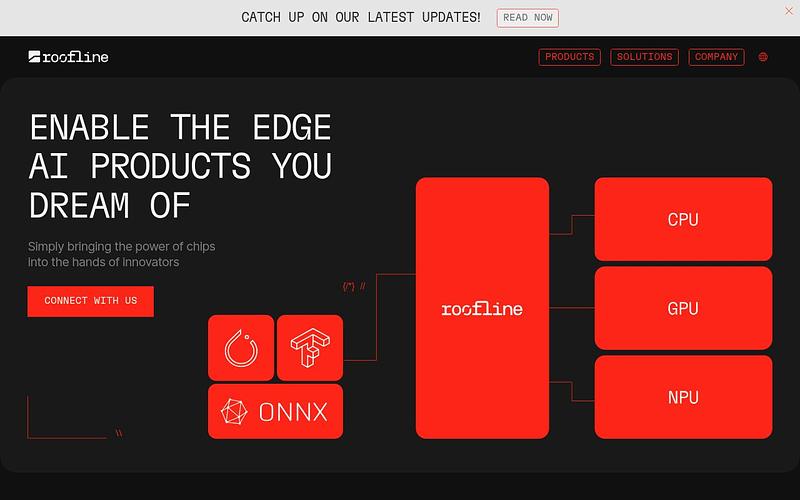
The stack is built on MLIR and IREE, translating models from major AI frameworks and formats, including PyTorch, TensorFlow and ONNX, into executables tuned for the CPUs, GPUs and NPUs in heterogeneous systems. Coverage spans ARM Cortex-M through Apple Silicon and RISC-V, with NXP eIQ Neutron on the NPU side.
NXP and Arm are named as working with Roofline on edge platforms. Roofline chairs the Technical Steering Committee of IREE, the open-source project its stack is built on. Licensing is a subscription that scales with usage, quoted through sales.
Pricing: Subscription that scales with usage, quoted through sales
What is Roofline?
Roofline is an edge AI deployment stack: a compiler, a device runtime and benchmarking tools for getting trained models running on the CPUs, GPUs and NPUs inside shipping hardware. The target is edge hardware in industrial, automotive, robotics and mobile products, where fragmented hardware and software stacks can make deploying new AI models slow and engineering-intensive.
The company was founded in 2024 as a spin-off from RWTH Aachen University in Germany.
How it works
The compiler is built on MLIR and IREE. Models from major AI frameworks and formats, including PyTorch, TensorFlow and ONNX, are lowered through layered intermediate representations into executables tuned for a specific hardware backend, rather than converted by a per-chip toolchain written by hand. A lightweight runtime then executes the compiled model on the device and orchestrates work across the SoC, so a workload can run heterogeneously across CPU, GPU and NPU.
That architecture is the argument. Supporting a new chip or a new model normally means model- and hardware-specific engineering that does not carry over to the next one. A retargetable compiler is meant to make that work reusable, which is where the claimed reduction in duplicated effort comes from.
Position in IREE
Roofline holds the chair of the IREE Technical Steering Committee. IREE is a sandbox-stage project of the LF AI & Data Foundation, and as of September 2026 its CONTRIBUTING.md lists eight voting TSC members: six from RooflineAI, including chairperson Maximilian Bartel, and two from AMD. For anyone weighing a dependency on IREE, that is a checkable fact about who steers it.
Hardware support
Published on the Roofline site as of September 2026:
- CPU: ARM Cortex-M, ARM Cortex-A, ARM SVE, Apple Silicon, Qualcomm Oryon, Qualcomm Kryo, Google Tensor, AMD x86-64, Intel x86-64, RISC-V
- GPU: ARM Mali, ARM Immortalis, Qualcomm Adreno, Apple Silicon GPU, Nvidia RTX family
- NPU: NXP eIQ Neutron
Roofline additionally lists RISC-V RVV, RISC-V VME, ARM SME and Qualcomm Hexagon as supported. Several targets carry a published case study.
Model support
The compiler is described as architecture-agnostic, covering CNNs, RNNs, LLMs, VLMs, MoE models and VLAs. The site's supported-model list spans LLM, vision, language, audio and radar workloads, naming Liquid AI LFM2.5, Gemma 3, Qwen 3, Llama 3.2, Phi-2, YOLO, ResNet, MobileNet, Whisper and others.
Two recent pieces of work are documented rather than asserted. In June 2026 Roofline published a case study adding native mixture-of-experts support to its IREE-based stack, compiling IBM Granite 3.1 1B-A400M, Liquid AI LFM2-8B-A1B and Qwen-REAP-15B-A3B end to end. In July 2026 it showed day-0 support for Liquid AI's LFM2.5-230M running on the CPU and eIQ Neutron NPU of NXP's i.MX 95.
There is also a May 2026 paper on vector-length-agnostic code generation for Arm SVE, reporting up to 1.5x over IREE's existing NEON path and up to 3.4x when scaling from 128-bit to 512-bit SVE in a cycle-level simulation.
Pricing
No public price list. Roofline describes its commercial arrangement as a subscription that scales with usage, quoted through sales. The site's licensing page splits access into a non-commercial tier (unlimited developer access inside an organisation, coverage for selected models, documentation and stability guarantees) and a commercial tier that adds deployment to customers, guaranteed coverage for TFLite, PyTorch and ONNX models, continuous optimisation work and premium support.
Who should use it
Chip and IP vendors, and product teams, that need to deploy a broad range of AI models across CPUs, GPUs and NPUs without rebuilding the software stack for every new model or hardware target. The concrete cases: an SoC with an NPU whose vendor toolchain covers a subset of the models you need, or a product line spanning several chips where each one currently means a separate deployment path. Roofline's argument is that reusable compiler infrastructure gives broad model and hardware coverage while keeping performance across targets.
Roofline addresses a different deployment problem from tools such as llama.cpp, Ollama and vLLM. Those run models through established CPU and GPU execution paths, mostly on developer machines or servers, and are open source. Roofline builds compiler and runtime infrastructure for deploying across heterogeneous edge hardware, including NPUs, and is commercially licensed. Teams that need a model running on a laptop this afternoon want the former; chip vendors and product teams facing a bring-up across several hardware targets are the ones this addresses.
Frequently Asked Questions
How much does Roofline cost?
Roofline describes its commercial arrangement as a subscription that scales with usage, quoted through sales; there is no public price list. The licensing page splits access into a non-commercial tier (unlimited developer access within an organisation, coverage for selected models, documentation and stability guarantees) and a commercial tier that adds deployment to customers, guaranteed coverage for TFLite, PyTorch and ONNX models, continuous optimisation and premium support. Verified against roofline.ai on 1 September 2026.
Which chips and NPUs does Roofline support?
On CPU: ARM Cortex-M, ARM Cortex-A, ARM SVE, Apple Silicon, Qualcomm Oryon, Qualcomm Kryo, Google Tensor, AMD x86-64, Intel x86-64 and RISC-V. On GPU: ARM Mali, ARM Immortalis, Qualcomm Adreno, Apple Silicon GPU and the Nvidia RTX family. On NPU: NXP eIQ Neutron. Roofline also lists RISC-V RVV, RISC-V VME, ARM SME and Qualcomm Hexagon as supported targets. Several of these carry a published case study on the Roofline site, and the company states it is actively working on interface standardisation for RISC-V. Verified against roofline.ai on 1 September 2026.
Which model architectures does Roofline support, and how fast do new ones land?
Roofline describes the compiler as architecture-agnostic, spanning CNNs, RNNs, LLMs, VLMs, MoE models and VLAs. According to the company, a new model on an already-supported architecture typically takes hours to days; a genuinely new architecture needing a new compiler feature can take weeks to months, as mixture-of-experts did. Both ends of that are documented publicly: a June 2026 case study covers adding native MoE support and compiling IBM Granite 3.1 1B-A400M, Liquid AI LFM2-8B-A1B and Qwen-REAP-15B-A3B, while a July 2026 post shows day-0 support for Liquid AI's LFM2.5-230M on NXP i.MX 95 CPU and NPU.
What does integrating Roofline involve, and how long does it take?
It depends on the target. CPUs and GPUs have standardised interfaces and take minimal integration effort. NPUs depend on the complexity of the hardware and how ready its backend is: for complex hardware, Roofline puts time-to-first-model at typically three to four months, followed by performance optimisation. That figure comes from the company rather than from published benchmarks.
How is Roofline different from llama.cpp, Ollama or vLLM?
Different deployment problem. llama.cpp, Ollama and vLLM run models through established CPU and GPU execution paths, mostly on developer machines and servers, and are open source. Roofline is commercially licensed compiler and runtime infrastructure for deploying across heterogeneous edge hardware, including NPUs such as NXP eIQ Neutron and microcontroller-class parts like ARM Cortex-M, and compiles ahead of time for a specific backend rather than loading weights at runtime. If the goal is a model running locally on a workstation, the open-source runtimes are the shorter path. Roofline suits chip vendors and product teams needing broad model coverage across several hardware targets without a separate deployment path for each.
Is Roofline open source?
The product is commercially licensed, but it is built on the open-source MLIR and IREE projects and Roofline is a significant contributor to IREE. IREE is a sandbox-stage project of the LF AI & Data Foundation, and as of September 2026 its published TSC roster lists eight voting members, six from RooflineAI including chairperson Maximilian Bartel, and two from AMD. Roofline has also published open-source tooling around MLIR, such as mlir-track-src, and presents at EuroLLVM.
Roofline Alternatives
Explore 41 products in the Frameworks & Stacks category. View all Roofline alternatives.

llama.cpp
LLM inference in C/C++ with broad hardware support and aggressive quantization

vLLM
High-throughput LLM inference engine with PagedAttention for efficient GPU memory usage


Linkly AI
Local document search engine that exposes your files to AI agents over MCP

AGNT
Local-first desktop workspace for building and running agents, with visual workflows, memory and MCP connections

CloudPloy
MCP server that lets a coding agent deploy apps to your own servers or cloud account
Is your product missing?