The EU AI Act's Transparency Rules: What Builders Actually Need to Check
/ Arvid Andersson
Article 50 of the EU AI Act applied from 2 August 2026. It is the transparency article: who has to say that something was made by a machine, and in what form. This is a builder's read of which parts are yours to implement and which belong to whoever supplies your model. It is not legal advice. The links go to primary sources so you can check any of it yourself.
The short version
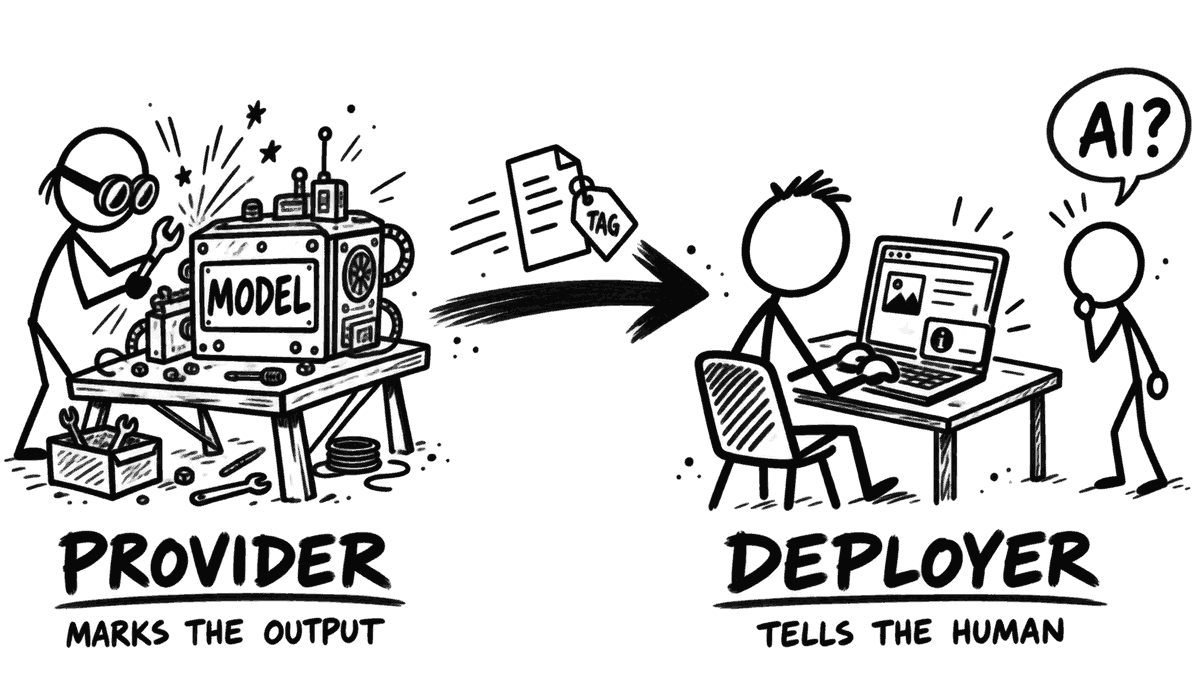
- Providers mark, deployers disclose. The machine-readable marking duty sits with whoever builds and ships the generative system. If you call a hosted model, that is usually not you.
- Free-form text is the carve-out, not the headline. The Code of Practice asks for two marking layers on audio, images, video and containerised text, and accepts one for free-form text.
- Nothing changed in the text this year. The machine-readable requirement has been in Article 50(2) since 2024. What happened in 2026 is that it started applying.
Start here: are you a provider or a deployer?
Almost every confusion about Article 50 comes from skipping this question. The article puts different duties on different parties. The one people panic about, machine-readable marking, lands on the provider.
A provider, per Article 3(3), develops an AI system or has one developed and places it on the market or puts it into service under its own name or trademark. A deployer, per Article 3(4), uses an AI system under its own authority, except in a personal non-professional activity.
If you call an LLM API and ship a feature on top, you are usually a deployer of that model. If you fine-tune, package, and sell a system as your own product, you are closer to a provider. Plenty of teams are both, in different parts of the same codebase.
This matters because the machine-readable marking duty in Article 50(2) sits with the provider of the generative system. A deployer building on someone else's model does not discharge it by adding a tag in their own DOM, and often cannot: the mark is meant to be applied at generation.
The duties, in the order you will hit them
Article 50(1): tell people they are talking to an AI. Providers must design systems that interact directly with people so those people are informed they are dealing with an AI, unless that is obvious "from the point of view of a natural person who is reasonably well-informed, observant and circumspect". A chat widget labelled as a bot clears this easily.
Article 50(2): mark generated output in a machine-readable format. The provider duty. Outputs of systems generating synthetic audio, image, video or text must be marked and detectable as artificially generated. The regulation asks for solutions that are "effective, interoperable, robust and reliable", then adds the qualifier that does most of the work in practice: "as far as this is technically feasible". It does not apply where the system performs an assistive function for standard editing, or does not substantially alter the input data or its semantics.
Article 50(3): emotion recognition and biometric categorisation. A deployer duty. Anyone exposed to such a system has to be informed of its operation, with the personal data handled under GDPR. Narrow scope, and no technical-feasibility escape hatch.
Article 50(4): disclose deepfakes and public-interest text. A deployer duty, about human-visible disclosure rather than metadata. Two limbs: deepfake image, audio or video must be disclosed as artificially generated, and text published to inform the public on matters of public interest must be disclosed too. The second limb has an exception: it does not apply where the content underwent "human review or editorial control" and a natural or legal person "holds editorial responsibility for the publication". An AI-drafted article a named editor checked and stands behind is treated differently from an unreviewed feed.
Article 50(5): when and how you say it. The information has to reach people "in a clear and distinguishable manner at the latest at the time of the first interaction or exposure", and has to meet applicable accessibility requirements. Disclosure buried in a settings page does not obviously satisfy "first interaction".
What "machine-readable" means for text
Text is where this gets awkward, and the guidance says so itself.
The Commission's Code of Practice on marking and labelling AI-generated content, published in final form on 10 June 2026, is voluntary. It is not the law; it is one documented way to show you are meeting it. Providers who skip it have to demonstrate compliance "through alternative equivalently adequate means".
Its baseline asks for two layers of machine-readable marking: digitally signed metadata, and an imperceptible watermark. Read which content that applies to. The Code requires the two-layer approach for "audio, images, video, and containerised text", and then says this about the rest:
given that free-form text cannot transport metadata, a single-layer of marking as described in Sub-measure 1.1.2 is considered sufficient to comply with the requirements of Article 50(2) AI Act for this specific type of content.
So free-form text needs the watermark, not the metadata. The watermark requirement has a floor of its own: the Code exempts "very short text", defined as text shorter than 200 tokens. Current techniques cannot watermark anything shorter with even a basic level of reliability. Above 200 tokens watermarking applies, with the Code conceding it "may have lower reliability".
That concession has a consequence. Because free-form text watermarks are less reliable, the Code lets providers restrict access to the detection tool rather than publishing it openly. The restriction is narrower than it sounds: market surveillance authorities, regulators, law enforcement, media, fact-checkers, trusted flaggers, researchers and civil society organisations all keep access.
The available techniques are immature:
- C2PA / Content Credentials is the most deployed provenance standard and is mostly used on files. Its specification does cover unstructured text: since version 2.3 it defines embedding a manifest using invisible Unicode variation selectors, plus external manifest repositories for assets that cannot carry one inline. The reference implementation,
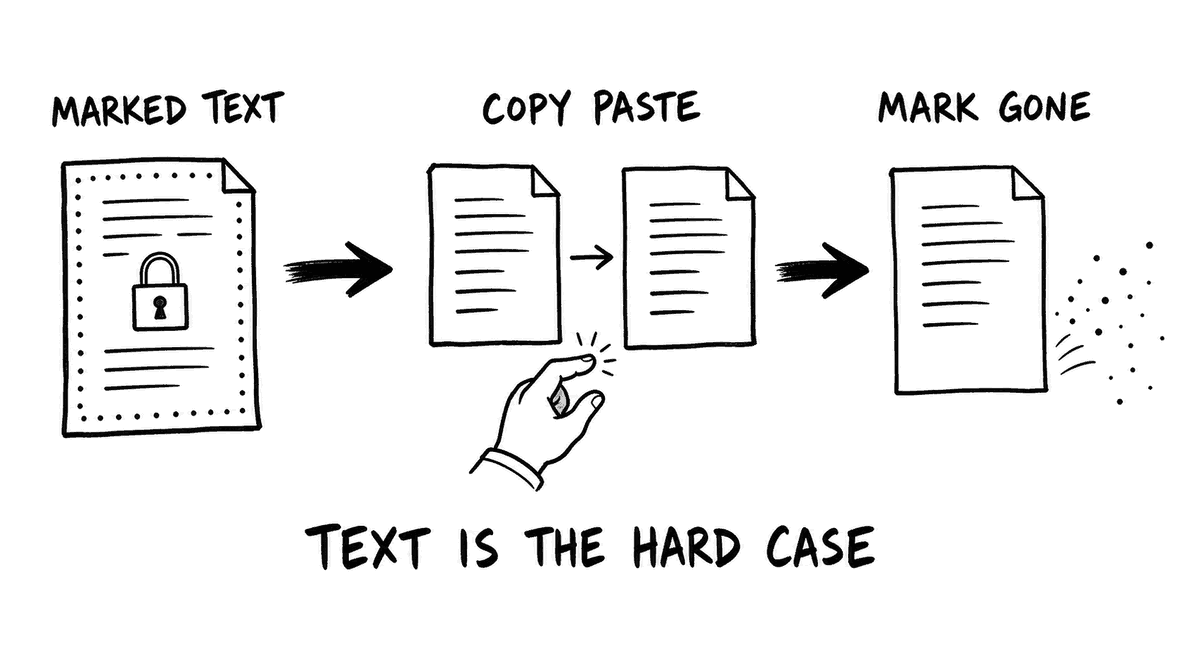
c2pa-rs, does not list plain text among its supported formats. Invisible codepoints also do not survive much: plain-text conversion and re-typing strip them. - Token-distribution watermarking embeds a statistical signal in the model's word choices. It degrades on short passages, which is exactly why the Code sets a 200-token floor and permits restricted detection access for text.
- Screenshots break everything. A re-captured image of text carries no provenance at all.
That immaturity is a reason to be sceptical of any vendor selling a solved, robust text watermark today, not a reason to ignore the duty. CEN-CENELEC's JTC 21 is still working on the harmonised standards, which leaves no settled conformity route to point at yet.
The checklist
Ordered roughly by how often each one gets missed.
- Work out which role you are in, per feature. Write it down. The answer can differ between your chatbot and your content pipeline.
- Ask your model provider what they mark, and how. The highest-value question on this list and the one almost nobody asks. If you are a deployer, their marking is the marking. Ask whether they apply C2PA credentials, whether they watermark text, and whether the mark survives their streaming API.
- Check whether disclosure reaches every surface. If generated content flows from your app into a support ticket, an email, or an export, and only your web UI carries the label, the label is not doing its job.
- Decide who holds editorial responsibility for published text. If the answer is a named person and there is a real review step, the 50(4) text limb may not bite. If the answer is "the pipeline", it probably does.
- Check your dates. Article 50 has applied since 2 August 2026. If your generative system was on the market before then, the Digital Omnibus added an Article 111 paragraph giving you until 2 December 2026 for the 50(2) marking duty specifically. That is a transitional runway for existing systems, not a general deadline. It is widely misreported as one.
- Note where your provider is, and under whose law it operates. Separate from Article 50. It is the question that usually arrives in the same meeting.
Two things circulating that are not right
"The rules changed, visible text is no longer enough." The machine-readable requirement in Article 50(2) has been in the adopted text since 2024. What changed in 2026 is that the obligation started applying, plus a Code of Practice and Commission guidelines arrived to say how to meet it. The visible-disclosure duty in 50(4) was never replaced. They are parallel obligations on different parties.
"Everyone building with AI needs to implement a machine-readable tag." Only if you are the provider of the generative system. Most teams building on a hosted model are deployers, whose 50(4) duties are about disclosure to humans.
The jurisdiction question that arrives with it
Infrabase does not track Article 50 conformance per product, and would be inventing it if it claimed to. What it does track, verified from each company's own legal pages, is jurisdiction: which company is behind a tool, where it is headquartered, and whether it publishes GDPR and SOC 2 positions.
That is the useful adjacent fact. The transparency question usually gets asked in the same conversation as data residency. The second one is answerable from published evidence in a way the first is not yet. EU-headquartered inference providers in the directory with a verified GDPR position, as of October 2026:
Full list with country, category and compliance filters on the European AI infrastructure page.
Primary sources
Everything above is checkable. These are the documents it came from.
Related reading
Frequently asked questions
Does the EU AI Act require a watermark on AI-generated text?
Article 50(2) requires providers of generative AI systems to mark outputs in a machine-readable format, qualified by the phrase 'as far as this is technically feasible'. The Commission's Code of Practice, published in final form on 10 June 2026, treats free-form text as a case where a single layer of marking is sufficient, on the basis that free-form text cannot carry metadata. It also exempts 'very short text', which it defines as text shorter than 200 tokens, on the basis that current techniques cannot watermark anything shorter with even a basic level of reliability.
When did the AI Act transparency rules start applying?
2 August 2026, which is the AI Act's general application date under Article 113. Chapter IV, which contains Article 50, is not carved out into any of the earlier or later derogations. The Digital Omnibus (Regulation (EU) 2026/1744, in force 27 July 2026) moved several high-risk deadlines back but left the Article 50 date unchanged. Generative systems placed on the market before 2 August 2026 have until 2 December 2026 to comply with the Article 50(2) marking duty specifically.
Am I a provider or a deployer under the EU AI Act?
A provider develops an AI system, or has one developed, and places it on the market or puts it into service under its own name or trademark. A deployer uses an AI system under its own authority, except in a personal non-professional activity. A team calling a hosted model API and shipping a product on top is usually a deployer of that model. Many organisations are both, depending on the feature.
What are the penalties for breaching Article 50 of the EU AI Act?
Article 99(4) covers transparency obligations under Article 50 and sets administrative fines of up to EUR 15,000,000 or, for an undertaking, up to 3% of total worldwide annual turnover for the preceding financial year, whichever is higher. The Commission notes that proportionality can be taken into account for SMEs and small mid-cap companies.
Does human review remove the AI disclosure requirement?
For the Article 50(4) limb covering text published to inform the public on matters of public interest, the duty does not apply where the content has undergone human review or editorial control and a natural or legal person holds editorial responsibility for the publication. This exception does not affect a provider's separate Article 50(2) marking duty, which is a different obligation on a different party.
Is the EU AI Act Code of Practice on marking mandatory?
No. The Code of Practice on marking and labelling AI-generated content is voluntary. The underlying Article 50 obligations are legal requirements; the Code is one documented route to showing you meet them. Providers and deployers who do not adhere to it have to demonstrate compliance through alternative equivalently adequate means.
Browse European AI infrastructure on Infrabase.ai
Is your product missing?