Decision Models Explained: Jev, Clef, Laya and the Alternatives
, updated / Arvid Andersson
A decision model answers your code's question with a probability for each possible answer. Jev made the idea popular in September 2026. Within three weeks there were open-weight alternatives (Laya, Kev), open-weight models from Cloudflare (Clef) and Perplexity (pplx-decider), EU hosting (System1 Models) and a preview from OpenAI. They are fast and cheap enough to sit inside a loop. They are not a replacement for an LLM.
What a decision model is
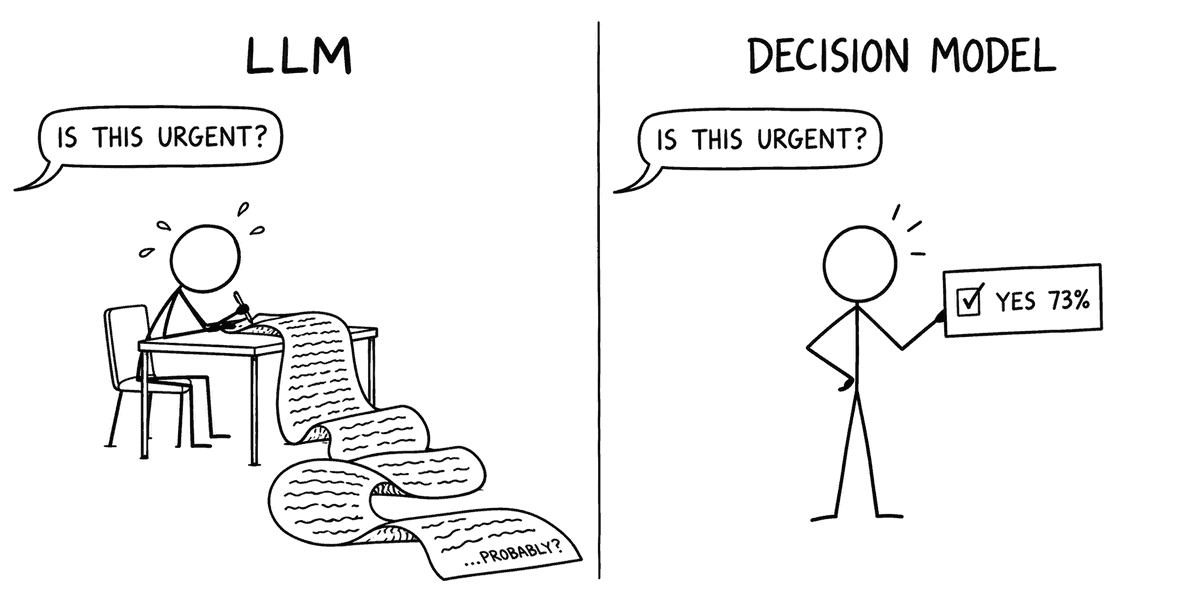
Most of what an application asks an LLM is not a request for prose. Is this ticket about billing? Should the agent call the search tool or the database tool? Is this message urgent? The answer is one of a few options. An LLM still produces it the way it produces everything else: token by token, as text your code then has to parse and trust.
A decision model skips the text. You send it a state (a message, a document, some JSON) and a set of typed questions. It returns an answer per question, with a probability for every allowed option:
- Choice: pick one option from a list you define.
- Score: rate something on levels you define.
- Yes/no: the probability that the answer is yes. TypeSafe calls this a "noul".
Because nothing is generated, all questions are answered in one pass. Pricing reflects that: Jev charges for input tokens only; output is free.
What it looks like in practice
In a test on 2 October 2026, Jev received a customer message ("I was charged twice for my October invoice and need the duplicate refunded before Friday") with three questions in one request: which team should handle it, whether it needs a reply within 48 hours and how frustrated the customer is on a four-level scale.
It answered billing with probability 1.0, urgent at 0.73 and frustration at 1.19 out of 3 (most weight on "mildly annoyed"). Eight requests took 0.22 to 0.28 seconds each from Sweden, network included. The request used 429 input tokens, which at Jev's listed $0.042 per million comes to about $0.00002.
At that price and speed you can ask on every incoming message or agent step.
For a hands-on look, five of them were tested as the first reader in front of an AI agent's inbox, on 16 emails in English and Swedish: Jev, Laya, Strom and System1 tested.
Decision models on Infrabase
Every listed decision model, pulled live from the directory.
| Product | Starting price | Alternatives |
|---|---|---|
| Celeris-1 Decision | $0.04 per 1M input tokens, output free | Alternatives |
| Clef | $0.038 per 1M input tokens (Clef-flash on Workers AI) | Alternatives |
| Decision Models | $0.019 per 1M input tokens (s1-fast), output free | Alternatives |
| Fastino GLiDE | $0.15 per 1M input tokens, output free | Alternatives |
| Heabsy | From $0.095 per 1M input tokens (flagship Qwen3.8 27B $1.00) | Alternatives |
| Inception Mercury Decide | $0.02 per 1M input tokens (50% promotion, list $0.04), output free | Alternatives |
| Kev | Free (open-source) | Alternatives |
| Laya | Free (open-source) | Alternatives |
| Liquid AI d1 | $2 free credit, then $0.02 per 1M input tokens | Alternatives |
| Mapika Decider | Free to self-host | Alternatives |
| Microsoft-Decision-1 | $0.042 per 1M input tokens, output free | Alternatives |
| Nace.AI Drex | $25 signup credit, then from $0.04 per 1M input tokens | Alternatives |
| Ollaya | — | Alternatives |
| OpenAI Decisions API | $0.10 per 1M input tokens, output free | Alternatives |
| Perplexity pplx-decider | $0.02 per 1M input tokens | Alternatives |
| Respan Span-01 | Free (Span-01 Lite), $0.02 per 1M input tokens (Pro) | Alternatives |
| ScaleDown Classify-1 | 1M free tokens, then $0.05 per 1M input tokens | Alternatives |
| Strands Decider | Free to self-host | Alternatives |
| Strom | $0.042 / 1M input tokens | Alternatives |
| TypeSafe Jev | $0.042 per 1M input tokens | Alternatives |
| Upstage Solar Decide | $0.10 per 1M input tokens, output free | Alternatives |
The options, as of October 2026
This table compares the first seven options on how you run them. Every decision model with its current hosts and verified prices is on the decision models page.
| Jev | Clef / Clef-flash | Laya | Kev | Decision Models | pplx-decider | OpenAI Decisions API | |
|---|---|---|---|---|---|---|---|
| Maker | TypeSafe AI | Cloudflare | NandhaKishorM (GitHub) | Jared Palmer | productivity-boost.com (DE) | Perplexity | OpenAI |
| Weights | Closed | Open (Apache-2.0) | Open (Apache-2.0) | Open (Apache-2.0) | Hosts open models | Open (Apache-2.0) | Closed |
| How you run it | Hosted API | Workers AI or self-host | Self-host, or hosted by Berget AI, Runware and Boundless | Self-host | Hosted API | Perplexity API or self-host | Hosted API (public beta) |
| Price, hosted | $0.042 / 1M input | $0.24 / $0.038 per 1M input | €0.042 / 1M on Berget, $0.02 on Runware (free until 12 Oct) | Free to run | From $0.019 / 1M input (s1-fast); s1-pro $0.080 for new customers, EU tier slightly more | $0.02 / 1M input | $0.10 / 1M input |
| Context | 64K per request (32K state + longest question) | 65,536 tokens (Clef-flash 24,576 on Workers AI) | 512 (English), up to 8,192 (multilingual) | Up to 65,536, validated 8,192 | 4,096 tokens per request | Up to 262,144 tokens per request | Not published |
| Images | No | Images and video | No | No | One image (s1-vision) | Images (PNG, JPEG, WebP) | Images (inline base64) |
| Jev-compatible API | n/a | Yes | Own API | Yes | Yes | Own endpoint, same question types | No |
Prices and specs checked against each provider's own pages, 2 October 2026; the Laya hosts on 3 October; OpenAI, pplx-decider and Decision Models on 15 October. See all Jev alternatives in the directory.
What the table doesn't show:
- Laya works best fine-tuned. Its own benchmark shows accuracy going from 0.362 zero-shot to 0.766 after fine-tuning on the task. The English checkpoint reads 512 tokens; the multilingual one handles 100+ languages and up to 8,192 tokens if you raise the limit.
- Kev and Clef speak Jev's API. You can point TypeSafe's SDK at them, which makes switching cheap. Kev's README reports its own benchmark scores against Jev; Cloudflare reports its own for Clef. Both are self-reported; test on your own data before relying on them.
- pplx-decider reads the most at once. Perplexity's model takes up to 262K input tokens per request, images included, at $0.02 per million input tokens, about half what Jev charges. Perplexity reports 85.7% across 11 benchmarks against 84.5% for Jev, measured through its own API. Like the other scores here, that is self-reported.
- You can run them like Ollama. Ollaya pulls Laya, Kev, Clef and other decision models by name and serves them locally on Jev's endpoint, on CPU or GPU.
- OpenAI's version is a different design. Its Decisions API, announced at DevDay (29 September 2026) and now in public beta, uses gpt-6-luna, a general-purpose model, to choose from predefined answers. At $0.10 per million input tokens it costs more than twice what Jev does. OpenAI has not said whether its probabilities are calibrated, which is the property the purpose-built models are trained for.
- EU options exist. Decision Models (decisionmodels.io, formerly System1 Models) runs an EU-only tier on contracted EU operators with a DPA. Berget AI hosts Laya in Sweden. OpenAI offers European data residency on its Decisions API for eligible customers. See the European AI providers list for more.
What people build with them
A community list of open-source Jev projects (awesome-jev-projects) keeps showing one pattern: the decision model sits inside a loop and makes the small calls a bigger model would be slow and expensive for.
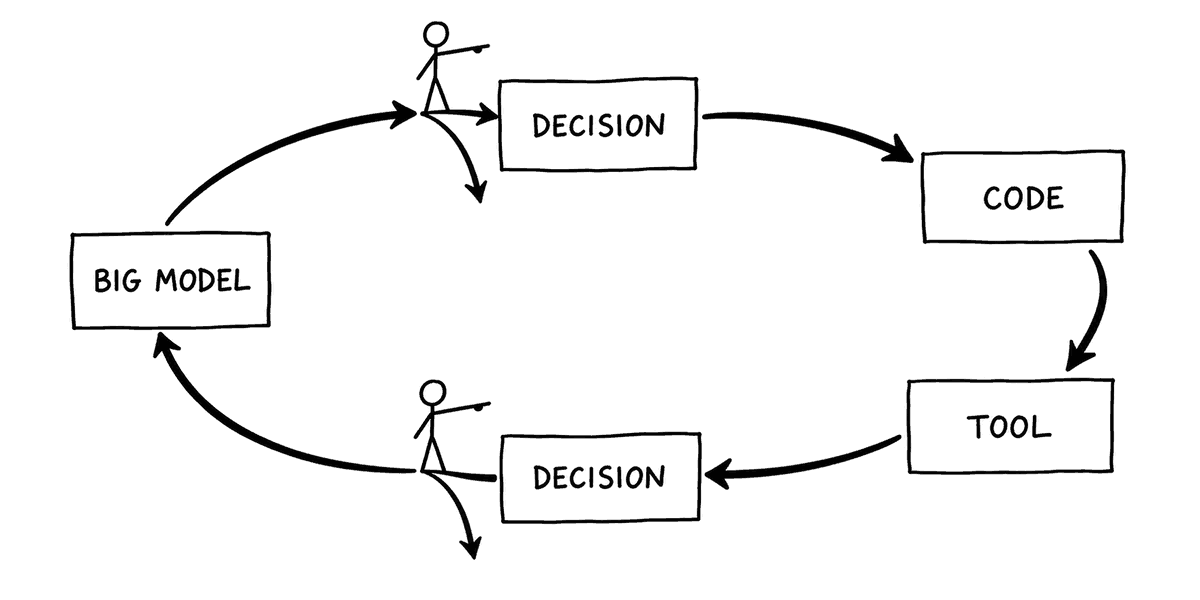
- Routing: decide which model, team or handler gets a request. See AI gateways explained for the gateway side of this.
- Context pruning: score old tool output and drop what no longer matters before the next agent turn.
- Guards: check input and output for policy problems before they reach a user. The guardrails comparison covers the dedicated tools.
- Agent referees: judge whether an agent's "done" is backed by test output, before anyone trusts it.
- Re-ranking and filtering: score retrieved passages or dataset rows, then let code decide what to keep.
When not to use one
- You need text. Decision models choose; they don't write. Pair one with an LLM rather than replacing it.
- You have labelled data and one fixed task. A small model fine-tuned for that task can beat a general decision model. It also runs anywhere. indecis (MIT, Go) is one library for training tiny ones that run on a CPU.
- Your input is long. Context limits range from 512 tokens to about 262K (pplx-decider). Check the model card for how accuracy holds up at your document length.
- Structured output from your current LLM is good enough. If you already call an LLM with a JSON schema and the latency and cost are fine, adding another model is extra moving parts. If that is where you are, there is no reason to switch yet.
FAQ
What is a decision model?
A model that answers typed questions (choice, score, yes/no) about some input with a probability for each possible answer, instead of generating text.
What are the open-source alternatives to Jev?
Laya, Kev, Cloudflare's Clef and Perplexity's pplx-decider publish open weights under Apache-2.0. Kev and Clef accept the same request format as Jev. Decision Models (formerly System1 Models) hosts open decision models behind a Jev-compatible API.
How much does a decision model cost?
Hosted prices start around $0.02 to $0.042 per million input tokens, with output free, as of October 2026. Perplexity's 27B pplx-decider is $0.02. OpenAI's Decisions API is $0.10. Clef is $0.24 per million input tokens on Workers AI, Clef-flash $0.038. Open weights cost only what you pay to run them.
Is OpenAI's Decisions API the same thing as Jev?
It solves the same problem with a different approach: a general-purpose model (Luna) restricted to predefined answers, rather than a model trained only for decisions. It is in public beta at $0.10 per million input tokens, with output free (October 2026).
Can a decision model see images?
Clef accepts images and video. Perplexity's pplx-decider accepts PNG, JPEG and WebP images. Decision Models' s1-vision accepts one image. Jev, Laya and Kev are text only; describe the image in text first.
AI Infra Digest
One email a month on what's new in AI infrastructure: launches, tools and price changes worth knowing. No spam, unsubscribe any time.
Is your product missing?